.png)

%20(1).png)
What the CEO Learned From Simply Being in the Classroom
Skillspire's CEO, Yasmin, has been spending more time in the classroom lately. Not to present. Not to inspect the curriculum. Just to observe.
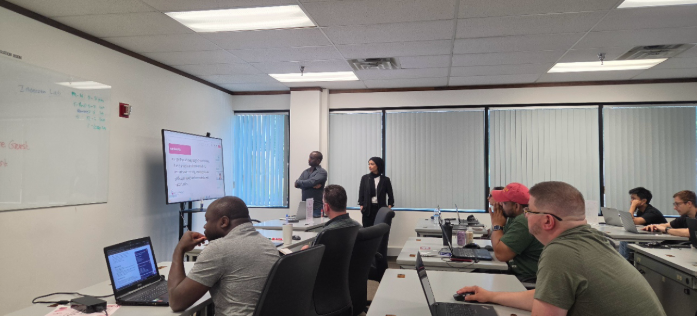
What she saw was more revealing than expected, and more instructive than any report could have offered. Students collaborating on assignments and job prospects. Instructors folding real experience from their own careers into the lesson at hand. Teaching assistants pulling up a chair beside someone who was stuck, patient with a question that had already been asked twice. Conversations drifting, unprompted, from syntax to interviews, to certifications, to introductions someone was willing to make.
And as the weeks went on, the classroom began to take on a life beyond the lessons themselves. Students started staying longer after class, eating together, studying together, and gradually making the space their own. Eventually, they brought in a refrigerator and began stocking it with food.
It was a small detail, easy to overlook. But it pointed to something larger about what a career change actually requires.
Most people evaluating a bootcamp ask the right first questions: tuition, schedule, length, curriculum. They should, those are the fundamentals, and they matter. But there's one more question worth sitting with before signing anything:
Who will be around me while I'm trying to become someone new?
Here is what Yasmin believes is worth looking for.
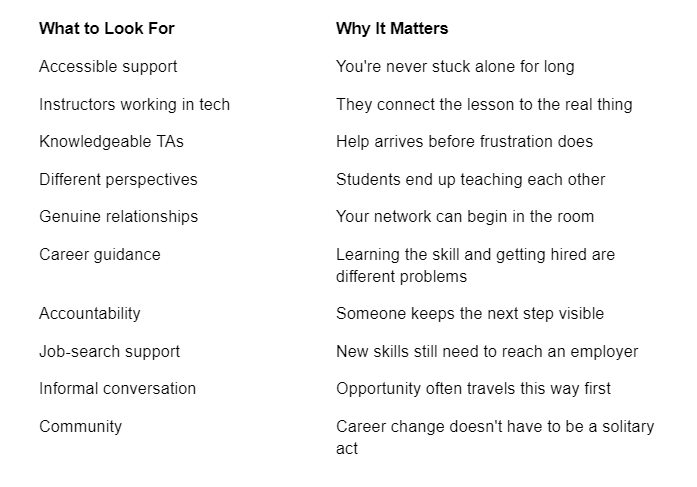
1. People You Can Actually Turn To
Getting stuck isn't a failure of the student, it's simply part of learning something difficult. Sometimes the instructor is who you need. Sometimes it's a teaching assistant. Sometimes it's only the person beside you, glancing at your screen and saying, "I had that exact problem yesterday."
The CEO has watched all three unfold in the same afternoon. What matters isn't only receiving the correct answer, it's seeing how someone else thinks through the same obstacle, and realizing there's more than one way to arrive at a solution.
When evaluating a bootcamp, don't stop at asking how many instructional hours you'll receive. Ask what happens in the moment you don't understand something, and who, specifically, you can turn to.
2. Instructors Who Understand the Industry, Not Only the Material
There's a meaningful difference between knowing how technology works and knowing how it's used, under pressure, inside a real organization.
Skillspire's instructors are working programmers, engineers, and technology professionals with experience at established companies. That distinction opens a different kind of question in the classroom: Is this how your team actually does it? What would you expect from a junior developer? What happens when this fails in production?
For someone entering the field for the first time, that context isn't a bonus, it's the difference between memorizing a concept and understanding its consequences. As you research a program, look closely at who is teaching. Clarity of instruction matters, and so does proximity to the industry you intend to join.
3. Teaching Assistants Who Show Up When It Counts
An instructor can't sit beside every student at once, and not every student needs a full re-explanation. Sometimes what's needed is five focused minutes with someone who already understands the material and can meet you where you are.
That's the quiet value of a well-trained teaching assistant. A good TA will look at the problem alongside you, offer a different way into it, or answer the question you were reluctant to raise in front of the group. For a beginner especially, simply knowing that person exists makes the unfamiliar feel less overwhelming.
4. Classmates Who Bring Experiences You Don't Have
An adult classroom gathers people who, in almost any other setting, would never have crossed paths: veterans, career changers, working professionals, people who already speak the language of technology, and people encountering it for the first time.
The CEO has watched those differences become the curriculum itself. The experienced student helps the one still finding their footing. The beginner asks the question the rest of the room was too self-conscious to raise. Someone arriving from an entirely different field sees the problem sideways, and that angle turns out to be the useful one.
The instructor leads, but eventually the students begin teaching each other and that shift is where real learning tends to live.
5. A Network That Forms Without Trying
Career changers are told, endlessly, to network. That advice is far easier to give than to follow when you barely know a single person in the industry you're entering.
A classroom changes the mechanics of that problem. Students spend months solving problems side by side. They come to know who is reliable, who has quietly mastered a certain skill, who asks the sharpest questions, who shows up to help without being asked twice. Then, without much ceremony, opportunity starts to move through the room — someone hears of an opening, someone else knows a person who knows a person.
None of this is guaranteed. But when you're rebuilding a career, being genuinely known by people who've watched you work carries real weight.
6. Career Support That Understands Where You're Coming From
Acquiring a technical skill and being hired for it are not the same challenge, and treating them as identical is one of the more common mistakes the CEO sees.
This distinction matters most for career changers and veterans, who bring years of experience from another field. Translating that experience into language a hiring manager recognizes is rarely intuitive. Leadership, communication, operational discipline, security, teamwork — these carry forward. The work is learning how to say so, clearly, to someone who has never seen your résumé before.
When comparing programs, don't simply ask whether career services exist. Ask what that support actually looks like for someone who has walked your particular path.
7. Someone Who Keeps You Accountable to Yourself
The beginning of a career change is exhilarating. The job search that follows is often the harder part. Applications go unanswered, interviews don't always become offers, and motivation comes and goes.
The CEO has come to deeply respect the role Skillspire's Student Success and Job Placement professionals play in this stretch of the journey. They follow up on goals, ask about the applications that were sent and the ones that weren't, and help identify what's quietly getting in the way, keeping the next step in view when it would otherwise be easy to lose sight of.
They can't find the job for you. That work remains yours, fully. But it helps more than people expect to have someone ask, "What's your next move?"
As you evaluate a program, find out whether career support is something you access occasionally, or whether there's a person who actually knows your goals and your progress by name.
8. Practical, Unglamorous Help With the Job Search
A strong technical foundation matters, but an employer still has to be shown, clearly, what you can do. That means résumés, LinkedIn profiles, portfolios, interview preparation, and project descriptions that make sense to someone outside the room where you built them.
None of this is as exciting as shipping your first application, but it's often what determines whether the skill you've built ever reaches the person who needs to see it. The CEO has watched capable students undersell real experience simply because the story wasn't told well on paper. Strong career support closes that gap, not by doing the work for you, but by teaching you to present what you've built with the confidence it deserves.
9. The Conversations That Were Never on the Syllabus
Some of the most valuable moments the CEO has witnessed happened entirely off the lesson plan, during a break, after class had technically ended. Students discussing interviews, certifications worth pursuing, companies that were hiring, a problem someone had been quietly stuck on for days. A laptop opens. An introduction gets made.
None of it was scheduled. It happened because people were in the same room, working toward something similar, and had begun, almost without noticing, to look out for one another.
10. A Place Where People Feel They Belong
Which brings this back to the refrigerator.
When students brought one in and began filling it with food, the CEO found themselves thinking about what that gesture actually represented. People don't typically do that in a place where they feel like temporary guests. These students were staying, eating together, studying, talking, making the room theirs.
For someone in the middle of a career change, that sense of belonging isn't incidental. You're stepping away from something familiar and agreeing, deliberately, to be a beginner again, not a comfortable place to stand. Having people around you who know your name, understand what you're working toward, and notice when you're struggling is what makes the transition survivable, and occasionally even enjoyable.
What to Look For, If Choosing Today
In-person learning isn't inherently superior to online learning. Online programs offer flexibility that many working adults and parents genuinely need. But if you're weighing an in-person bootcamp, don't choose one simply because it has a physical classroom.
Visit it, if you can. Meet the instructors and ask about their professional background. Ask whether teaching assistants are actually available, or only nominally so. Talk to current students and alumni. Ask what happens when someone falls behind, and what career support looks like once the training itself has ended.
Then notice the things that were never in the brochure: Do students know each other's names? Do they help one another without being asked? Does the staff know what each person is working toward? Would you feel comfortable admitting, out loud, "I don't understand this yet"?
You're not only choosing a curriculum. You're choosing the environment in which you'll attempt one of the more difficult transitions of your professional life.
How Skillspire Can Help
At Skillspire, students arrive from very different starting points. Some are veterans transitioning into civilian careers. Some are changing industries entirely. Some already carry technical experience; others are beginning from nothing at all.
Skillspire's programs, Software Engineering, Cybersecurity, Data Analytics, AI & Machine Learning, Java & AWS Cloud Computing, and C# & Azure Cloud, provide the technical foundation. Around that foundation is a community: instructors drawn from industry, teaching assistants who know the material and the students, classmates from every background imaginable, and Student Success and Job Placement professionals who help navigate résumés, applications, interviews, and everything else the job search demands.
No one can make this transition for a student. The learning, the practicing, the applying, the interviewing, the persistence when things move slower than hoped, that remains theirs to do. But doing the work yourself was never supposed to mean doing it alone.
Frequently Asked Questions
Q: What should I look for when choosing a coding bootcamp?
Curriculum, cost, schedule, and instructor quality all matter. But look, too, at the support surrounding the program — teaching assistants, career guidance, alumni connections, and what happens for a student who begins to struggle.
Q: Is an in-person coding bootcamp better than an online one?
Not inherently. Online learning offers flexibility that matters enormously for many people. In-person training tends to suit those who value face-to-face support, structure, and the relationships that form naturally among classmates and instructors.
Q: Does an instructor's professional experience actually matter?
Yes, often significantly. Instructors currently working in the field can connect technical concepts to how they're genuinely applied on professional teams — context that curriculum alone can't provide.
Q: Why does community matter in a coding bootcamp?
For career changers especially, classmates can become study partners, professional connections, and the first threads of a new network. A strong community also makes it easier to ask questions, stay accountable, and keep going when the material gets difficult.
Q: What career support should I look for?
Look for concrete help with résumés, LinkedIn, interviews, applications, and networking — but more importantly, ask who provides that support, and how present they remain throughout your job search, not just at the start of it.
.png)


