.png)

When people talk about AI careers, one language usually dominates the conversation: Python.
And yes — Python is important.
But here’s what most beginners don’t realize:
Python often builds the AI model.
Java is what helps companies actually run AI in the real world.
That difference matters.
In 2026, businesses are no longer experimenting with AI. They’re deploying it into banking systems, healthcare platforms, e-commerce apps, cybersecurity tools, logistics software, and enterprise cloud environments used by millions of people every day.
Those systems need to be fast, secure, scalable, and reliable.
That’s where Java developers are becoming extremely valuable.
Companies now need professionals who can connect AI tools to real business infrastructure — and Java is still one of the strongest technologies powering that infrastructure.
For career changers, upskillers, veterans, and professionals looking for stable high-income tech careers, learning Java today is not “old school.” It’s one of the most practical paths into cloud computing and AI integration jobs.
Why Java Still Dominates Enterprise Tech
Despite newer programming languages entering the market, Java continues to power some of the world’s largest systems.
Major industries still rely heavily on Java because it’s:
- Secure
- Stable
- Scalable
- Cloud-friendly
- Enterprise-tested
- Built for high-performance applications
Large companies cannot afford downtime, security failures, or unstable systems. That’s why Java remains deeply embedded in enterprise software architecture.
Industries actively hiring Java talent include:
- Financial technology
- Healthcare systems
- Cloud infrastructure
- Government contractors
- Cybersecurity companies
- E-commerce platforms
- Airline and logistics systems
- SaaS companies
- AI-powered enterprise tools
In other words, Java isn’t disappearing.
It’s evolving alongside AI and cloud computing.
The Rise of AI Integration Engineers
One of the fastest-growing tech roles right now isn’t just “AI Developer.”
It’s the ability to integrate AI into business systems.
Companies already have databases, apps, CRMs, APIs, cloud platforms, and internal software. They need engineers who can connect AI tools like large language models (LLMs) into those existing systems safely and efficiently.
That’s why AI integration skills are exploding in demand.
High-Demand AI + Java Roles in 2026
AI Integration Engineer
Builds the bridge between AI models and enterprise software systems.
Responsibilities include:
- Connecting AI chatbots to company platforms
- Building APIs for AI applications
- Integrating LLMs into customer support tools
- Managing AI workflows inside cloud environments
Cloud Data Engineer
Handles the massive data pipelines that AI systems rely on.
Tasks include:
- Managing cloud databases
- Building data processing systems
- Optimizing performance
- Ensuring scalable cloud infrastructure
Backend Developer (AI-Focused)
Creates secure backend systems powering AI products.
This includes:
- Authentication systems
- AI APIs
- Cloud microservices
- Enterprise security layers
These are not entry-level “toy app” jobs.
These are production-level roles companies pay well for because they directly affect business operations and revenue.
Why Cloud Computing and Java Go Together
Cloud computing is no longer optional.
Almost every modern company runs applications in the cloud using platforms like:
- Amazon Web Services (AWS)
- Microsoft Azure
- Google Cloud Platform (GCP)
And a huge percentage of enterprise cloud applications are still built with Java.
Why?
Because Java performs extremely well under heavy workloads.
For example:
- Banking apps processing millions of transactions
- Healthcare platforms managing sensitive patient data
- Airline systems handling global operations
- E-commerce sites serving thousands of users simultaneously
These systems require reliability at scale.
Java has proven itself for decades in exactly these environments.
The Modern Java Cloud Tech Stack Employers Want
If you want to become job-ready in today’s market, these are the technologies worth learning alongside Java.
Spring Boot & Spring AI
These frameworks help developers build modern cloud applications quickly.
Spring AI is especially important because it allows developers to:
- Connect applications to AI models
- Build AI-powered microservices
- Create chatbot systems
- Develop enterprise AI tools
This is becoming a major hiring advantage.
Docker & Kubernetes
Modern companies don’t simply “install apps” anymore.
They deploy containerized applications across cloud infrastructure.
Docker helps package applications.
Kubernetes helps manage them at scale.
These tools are now standard in cloud engineering jobs.
AWS, Azure, and Google Cloud
Cloud certifications and hands-on deployment skills matter.
Even basic cloud deployment experience gives candidates an edge because employers want developers who understand:
- Scalability
- Infrastructure
- Cloud security
- Deployment pipelines
- Monitoring systems
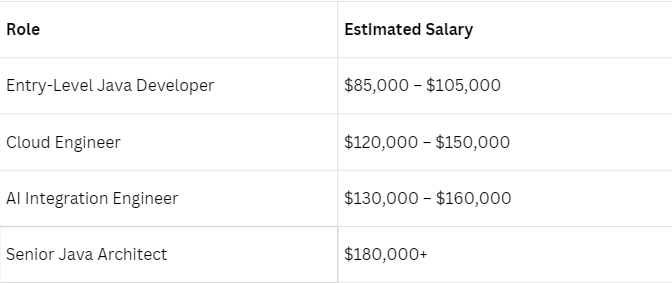
Java Salaries in 2026: What Can You Actually Earn?
One reason Java remains attractive is compensation.
Enterprise companies pay well because these systems are business-critical.
While salaries vary depending on location and experience, many U.S.-based roles currently fall within these ranges:
Is Java a Good Career Choice for Career Changers?
Yes — especially for people looking for long-term career stability.
A lot of beginners chase trendy tools without understanding market demand.
The reality is:
Companies still need engineers who can build stable systems that actually work in production.
That’s why Java remains strong.
It also teaches foundational engineering concepts that make it easier to grow into:
- Cloud computing
- Backend engineering
- DevOps
- AI infrastructure
- Enterprise software development
If you can learn Java properly, transitioning into other technologies becomes much easier later.
A Simple Roadmap to Learn Java for AI and Cloud Careers
Trying to learn everything at once usually leads to burnout.
A smarter approach is learning step-by-step.
Step 1: Learn Core Java
Focus on:
- Object-Oriented Programming (OOP)
- Variables and data structures
- APIs
- Multithreading
- Modern Java features
Strong fundamentals matter more than rushing.
Step 2: Build Real Projects
Don’t stay stuck in tutorials.
Build:
- REST APIs
- Cloud-connected apps
- AI chatbot integrations
- Backend systems
Employers care about proof of skills.
Step 3: Learn Cloud Deployment
Practice deploying applications to:
- AWS
- Azure
- Google Cloud
Even small deployment projects improve employability significantly.
Step 4: Understand AI Integration
You do not need to become an AI researcher.
You need to understand:
- APIs
- AI model integration
- Prompt workflows
- Cloud-based AI services
That combination is becoming extremely valuable.
Step 5: Build a Portfolio
Create GitHub projects showing:
- Clean code
- Cloud deployment
- API integrations
- AI functionality
Your portfolio often matters more than certificates alone.
Do You Need a Computer Science Degree?
No.
More employers are prioritizing:
- Skills
- Certifications
- Projects
- Problem-solving ability
A strong portfolio plus practical cloud experience can open doors even without a traditional degree.
This is especially true in bootcamp-based hiring pipelines where employers focus on job readiness.
Will AI Replace Java Developers?
No.
AI will automate repetitive coding tasks.
But companies still need engineers who can:
- Architect systems
- Secure infrastructure
- Design scalable applications
- Manage cloud environments
- Integrate AI into business operations
AI is becoming a tool developers use — not a replacement for skilled engineers.
The professionals who combine:
- Java
- Cloud computing
- AI integration
will likely stay highly employable for years.
Final Thoughts
The tech industry is changing fast.
But one thing remains true:
Companies still need people who can build reliable systems that solve real business problems.
Java continues to sit at the center of many of those systems — especially in cloud computing and enterprise AI.
If you’re considering a career transition into tech, learning Java today can open doors far beyond traditional software development.
It can lead into:
- AI integration
- Cloud engineering
- Enterprise backend development
- DevOps
- Scalable infrastructure careers
And those fields are growing.
For people serious about building durable, future-ready tech skills, Java is still one of the strongest foundations you can invest in.
Ready to upskill or to switch into tech? Join our upcoming Java and Cloud Computing Cohort
https://www.skillspire.net/courses/java-cloud-computing
.png)


